Water-Based vs. Lipid-Based Oral Care: Understanding the Differences
Water-based vs. lipid-based oral care: Last Updated: November 25, 2026. Reading Time: 8–10 minutes
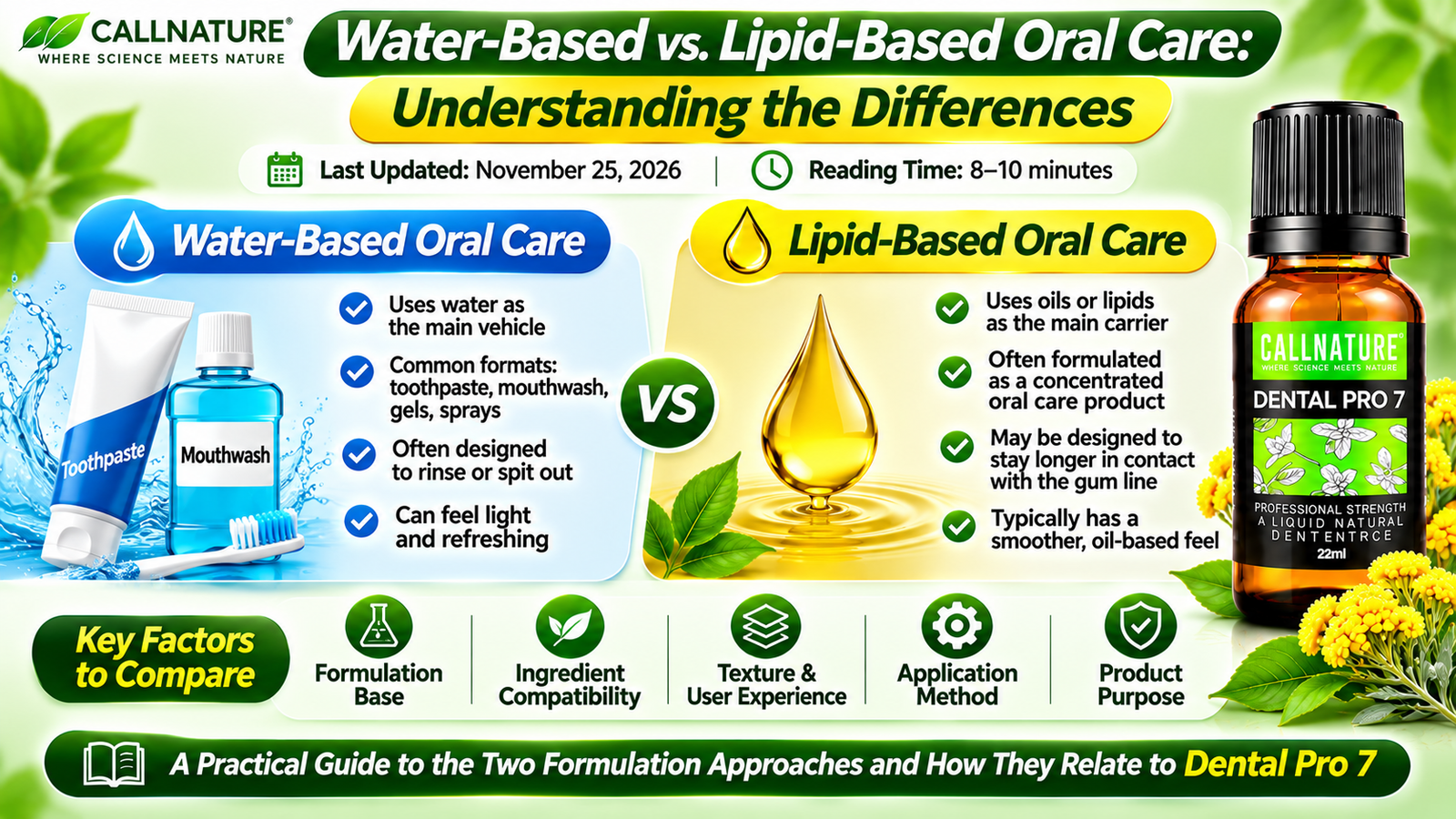
When choosing an oral care product, many people focus on its ingredients, flavor, or brand. However, the formulation base is another important factor to understand.
Some oral care products use water as their main vehicle, while others are formulated around oils or lipids. These different approaches can influence a product’s texture, ingredient compatibility, application method, and how it behaves in the mouth.
This guide explains water-based vs. lipid-based oral care, how the two formulations differ, and what consumers should consider when evaluating a product such as Dental Pro 7.
The goal is not to declare one formulation universally better. Instead, understanding the differences can help you choose oral care products that fit your routine and meet your dental needs.
What Is Water-Based Oral Care?
Water-based oral care products use water as a major component of their formulation. Water can act as a solvent or vehicle, helping distribute ingredients throughout a product.
Common examples include many:
- Toothpastes and dental gels
- Mouthwashes and oral rinses
- Oral sprays
- Water-based oral gels
Water-based formulations may also contain humectants, surfactants, flavoring agents, thickeners, and other ingredients. Each component serves a specific purpose depending on the product.
For example, water can help dissolve or disperse ingredients, while humectants such as glycerin or sorbitol help maintain moisture and influence texture. Surfactants may help with cleansing, foaming, or dispersing flavor oils.
Water-based products are often familiar and convenient. Many are designed to spread easily, rinse readily, and provide a refreshing sensation during daily oral care.
However, not all water-based products have the same composition or performance. A toothpaste, mouthwash, and oral gel may all contain water but behave differently because of their other ingredients and intended uses.
What Is Lipid-Based Oral Care?
Lipid-based oral care uses oils or other lipid-compatible materials as a major part of the formulation.
Lipids are a broad group of substances that includes fats, oils, and related compounds. In oral care products, a lipid carrier may be used to dissolve or disperse ingredients that are more compatible with oils than with water.
Lipid-based products can have a different texture and application method from conventional water-based products. Some are designed as concentrates rather than ready-to-use rinses.
A water-free formulation is often described as anhydrous, meaning that water is not intentionally included as a formulation ingredient. However, “lipid-based” and “water-free” are not always interchangeable terms: a product may contain both water and oil, such as an emulsion.
The exact formulation should therefore be understood from the product’s ingredient list and manufacturer information, rather than from the term “lipid-based” alone.
Water-Based vs. Lipid-Based Oral Care: Key Differences
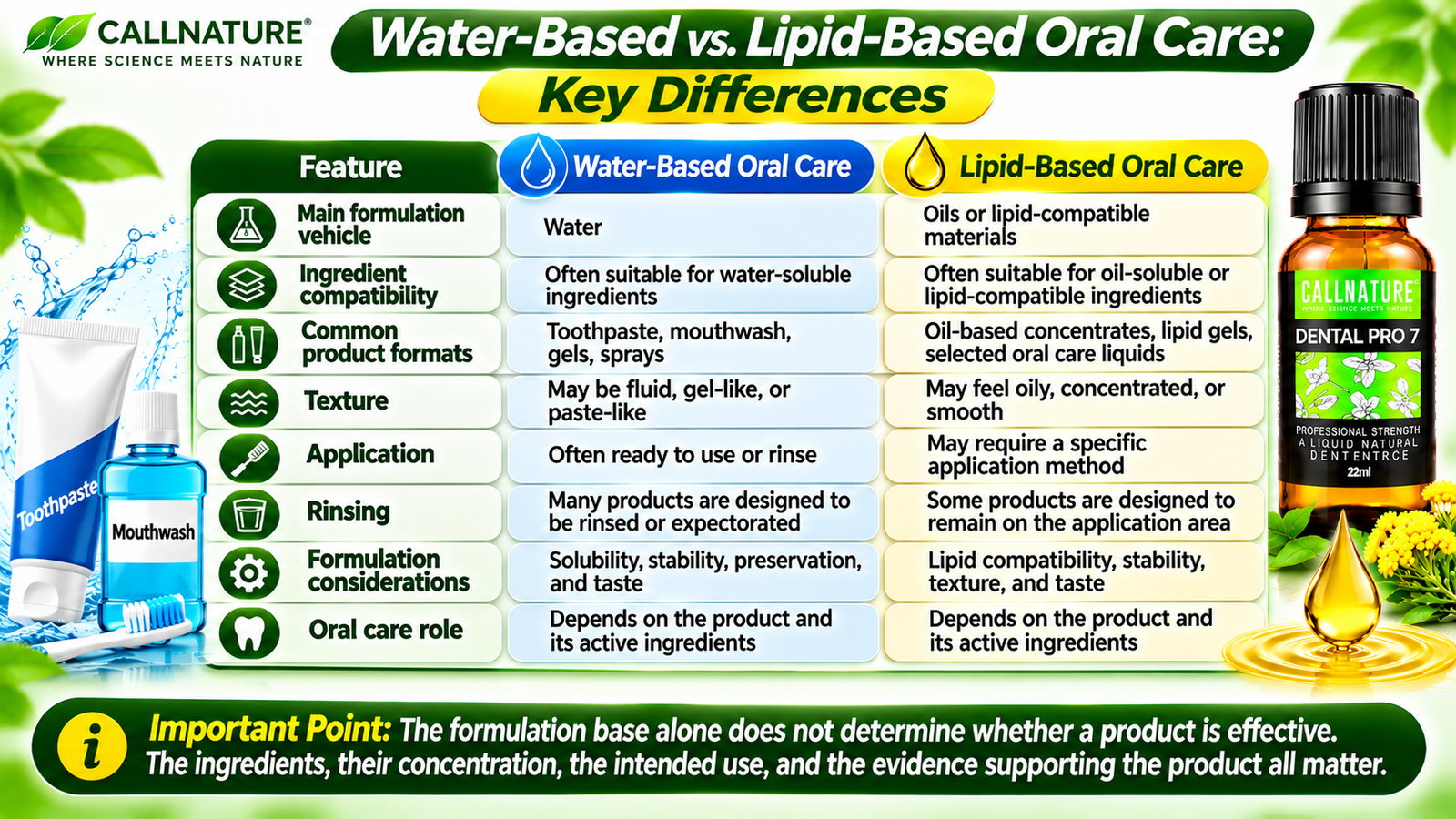
The following table provides a general comparison. Individual products may differ considerably.
| Feature | Water-Based Oral Care | Lipid-Based Oral Care |
|---|---|---|
| Main formulation vehicle | Water | Oils or lipid-compatible materials |
| Ingredient compatibility | Often suitable for water-soluble ingredients | Often suitable for oil-soluble or lipid-compatible ingredients |
| Common product formats | Toothpaste, mouthwash, gels, sprays | Oil-based concentrates, lipid gels, selected oral care liquids |
| Texture | May be fluid, gel-like, or paste-like | May feel oily, concentrated, or smooth |
| Application | Often ready to use or rinse | May require a specific application method |
| Rinsing | Many products are designed to be rinsed or expectorated | Some products are designed to remain on the application area |
| Formulation considerations | Solubility, stability, preservation, and taste | Lipid compatibility, stability, texture, and taste |
| Oral care role | Depends on the product and its active ingredients | Depends on the product and its active ingredients |
One important point: the formulation base alone does not determine whether a product is effective. The ingredients, their concentration, the intended use, and the evidence supporting the product all matter.
Does Water-Based Oral Care Wash Away More Easily?
Many water-based oral care products are designed to be rinsed away after use. Mouthwash, for example, is commonly swished around the mouth and then spat out.
But it would be inaccurate to say that every water-based product disappears immediately or cannot provide meaningful oral care.
Some water-based products contain ingredients designed to remain active or bind to oral surfaces. Their performance depends on the specific formulation and the ingredients used.
Similarly, a lipid-based product may have different surface-contact characteristics, but this does not automatically prove that it provides better results.
When comparing products, it is more useful to ask:
- What is the product designed to do?
- Which ingredients are included?
- How should it be applied?
- Is it intended to be rinsed or left in place?
- What evidence supports its intended benefits?
These questions provide a more balanced way to evaluate oral care than simply comparing the presence or absence of water.
Why Formulation Matters in Oral Care
The formulation base can influence several aspects of a product.
1. Ingredient compatibility
Some ingredients dissolve more readily in water, while others are more compatible with oils or lipids.
A formulator must choose a suitable vehicle to help keep ingredients properly distributed and stable. In some products, emulsifiers are used to combine water and oil phases.
2. Texture and user experience
Water-based products may feel light, fluid, or refreshing. Lipid-based products may have a smoother or more concentrated feel.
These differences can influence how comfortable a product is to use, but personal preference varies.
3. Application method
A water-based rinse may be used by swishing and spitting. A concentrated lipid product may have instructions for brushing or applying it directly.
Always follow the instructions for the specific product. Do not assume that a product should be rinsed—or left unrinsed—based only on its formulation category.
4. Product stability
Water-containing formulations may require appropriate preservation and stability systems. Water-free products have different formulation considerations, but they still need to be manufactured and stored properly.
Water-free does not automatically mean that a product is safer, more effective, or suitable for everyone.
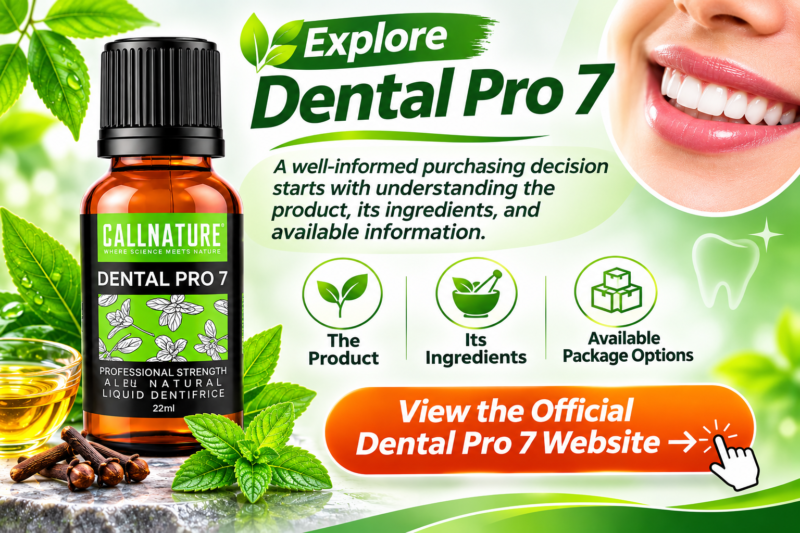
How Dental Pro 7 Uses a Lipid-Based Formulation
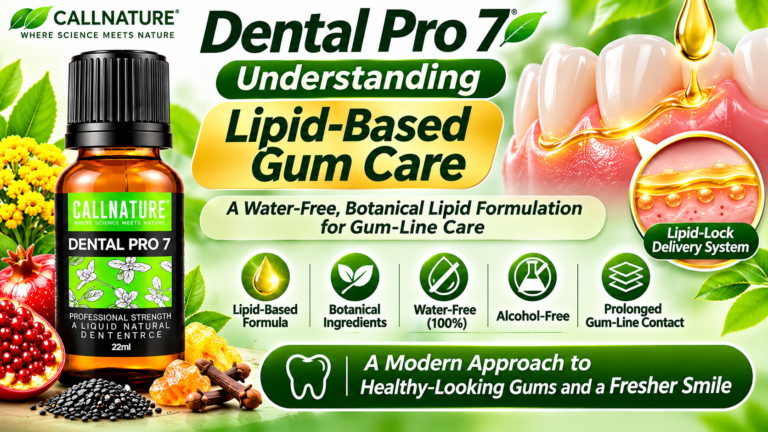
Dental Pro 7 is marketed by CallNature as a water-free, alcohol-free botanical lipid concentrate for cosmetic oral care.
According to the manufacturer, its formulation uses a lipid carrier and a delivery approach called “Lipid-Lock.” The product is presented as a concentrated gum-line care product rather than a conventional water-based mouthwash.
CallNature describes the product as intended to be applied with a toothbrush and left in contact with the gum line according to its instructions. Its formulation and application method differ from many conventional toothpaste and mouthwash products. Manufacturer product information
To understand the product more fully, readers may also explore:
- Dental Pro 7: Gum Care and How Its Lipid Formula Works
- Water-Free Gum Care: Dental Pro 7 Explained
- Lipid-Based Gum Care: Understanding Dental Pro 7
These articles provide additional context about the product’s formulation and how the manufacturer positions its lipid-based approach.
It is important to distinguish the manufacturer’s formulation explanation from independent clinical evidence. A lipid carrier may influence how a formula behaves on a surface, but the presence of lipids alone does not establish that a product treats gum disease or provides superior clinical outcomes.
Dental Pro 7 should be understood according to its stated cosmetic oral care purpose. It is not a substitute for professional dental treatment.
What About the Ingredients in Dental Pro 7?
The formulation base is only one part of a product. The ingredients themselves also deserve attention.
Dental Pro 7 highlights several botanical ingredients, including:
- Immortelle Helichrysum
- Pomegranate seed
- Black cumin seed
- Indian myrrh
- Wild clove
These are featured botanicals described in the product’s formulation information. They should not automatically be interpreted as the complete ingredient declaration.
For a closer look at the formulation, see:
- Dental Pro 7 Ingredients Guide
- Dental Pro 7 Review: Ingredients and Formulation
- Dental Pro 7 Ingredients: Cosmetic Oral Care Guide
When evaluating botanical oral care, consider the exact ingredient list, product instructions, and available evidence. “Natural” does not automatically mean risk-free, and botanical ingredients can cause sensitivity or irritation in some individuals.
Can Lipid-Based Oral Care Replace Toothpaste?
Not every lipid-based oral care product is designed to replace toothpaste, and not every water-based product serves the same purpose.
For routine dental care, fluoride toothpaste remains an important evidence-based option for helping prevent tooth decay. A cosmetic gum-care concentrate should not be assumed to provide the same cavity-prevention function unless its label and evidence specifically support that use.
If you are considering Dental Pro 7 as part of your routine, read the current manufacturer instructions and consider how it fits alongside your regular dental care.
For everyday oral care context, read Everyday Oral Care, Freshness, and Dental Pro 7.
If you have bleeding gums, persistent bad breath, pain, swelling, or other ongoing oral symptoms, consult a dental professional rather than relying on a cosmetic product alone.
How to Choose Between Water-Based and Lipid-Based Oral Care
The best choice depends on your oral care goals and the specific product.
Before buying, consider these practical points:
- Check the purpose. Is the product intended for cleaning, freshening breath, cavity prevention, or cosmetic gum care?
- Read the ingredients. Understand the main ingredients and any components that may cause sensitivity.
- Follow the instructions. Check whether the product should be rinsed, spat out, or left in contact with the mouth.
- Look for evidence. Do not rely only on claims about the formulation base.
- Keep up routine dental care. Continue brushing, interdental cleaning, and professional dental visits as recommended.
- Review the product details before purchasing. Check the current price, package, shipping information, and guarantee terms.
For more information about the product and purchasing options, see the Dental Pro 7 Buying Guide.
You can also read the Dental Pro 7 Product Experience 2026 for additional product-related information. Individual experiences are not the same as clinical evidence, so consider them alongside the product information and your own dental needs.
Where to Find Dental Pro 7
If you want to learn more about Dental Pro 7, use the following official CallNature websites:
- CallNature official website
- Dental Pro 7 official website
- Dental Pro 7 product store
- DP7 Dental – UK website
- CallNature customer contact page
Prices, available packages, shipping, and guarantee conditions may change. Review the current details on the official website before placing an order.
Affiliate Disclosure: This article contains affiliate links. If you purchase through these links, we may earn a commission at no additional cost to you. This does not change our aim to provide clear and informative product information.
Final Thoughts
Water-based and lipid-based oral care products use different formulation approaches, but neither category is automatically superior in every situation.
Water-based products are widely used because water can help dissolve and distribute ingredients, create convenient textures, and support familiar oral care formats. Lipid-based products use oils or lipid-compatible materials and may offer different ingredient compatibility and application characteristics.
The most meaningful comparison is not simply “water versus lipid.” It is how the complete formulation is designed, what the product is intended to do, how it should be used, and what evidence supports its claims.
Dental Pro 7 is one example of a water-free botanical lipid concentrate marketed for cosmetic gum care. Understanding its formulation can help consumers decide whether it fits their preferences, while maintaining appropriate expectations and continuing established dental care.
Disclaimer: This article is for general informational purposes only and is not a substitute for professional dental advice, diagnosis, or treatment. Dental Pro 7 is discussed as a cosmetic oral care product. It is not intended to diagnose, treat, cure, or prevent gum disease or any other medical condition. Consult a dental professional for persistent oral symptoms or questions about your dental care routine.